
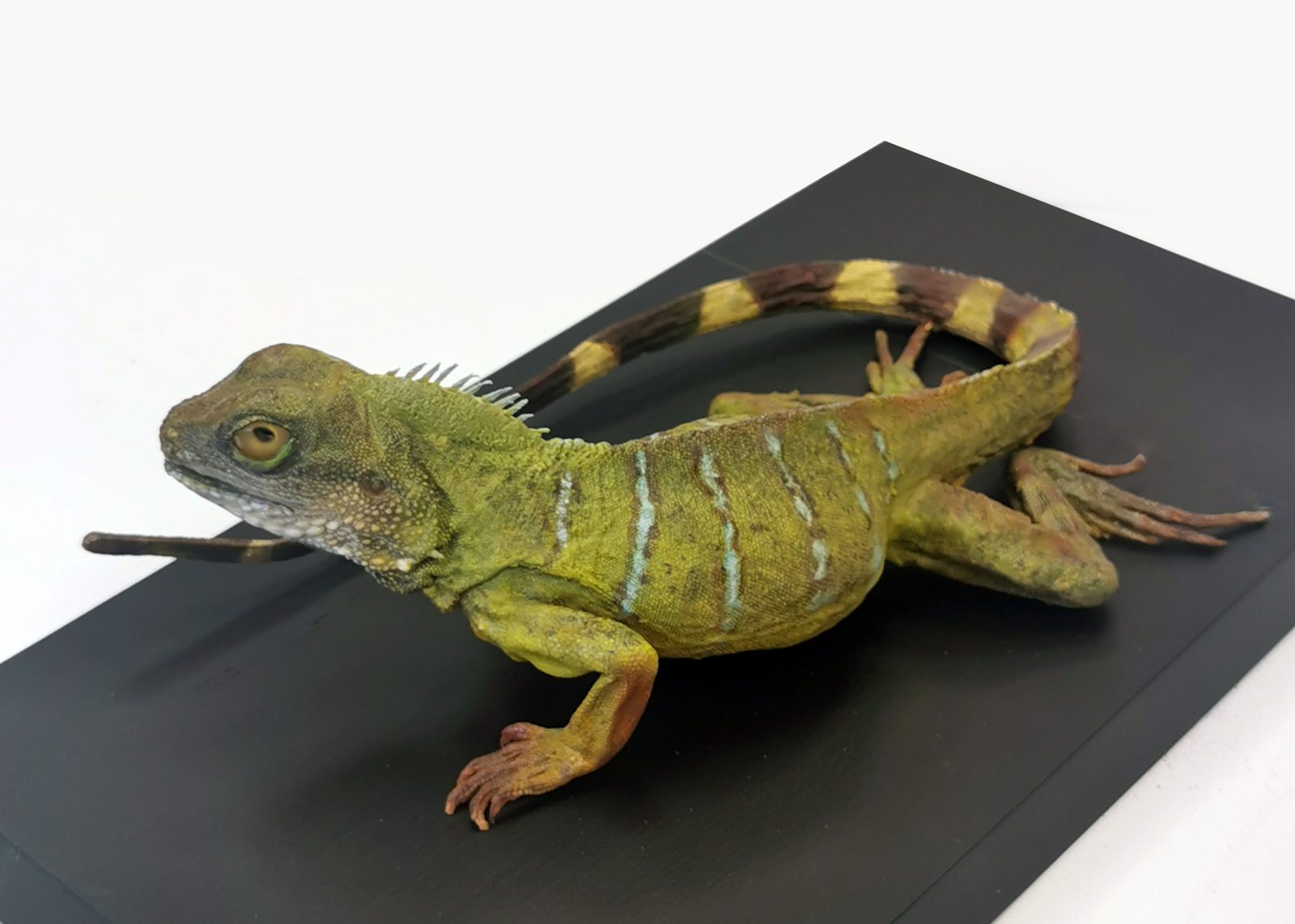
Water agamas (Physignathus cocincinus) are large lizards of the Agamidae family, also known as Chinese water dragons. Its distribution is confined to mainland Southeast Asia, encompassing Thailand, Southern China, Vietnam, and Cambodia. These lizards primarily inhabit the riparian zones of freshwater lakes and streams, as well as humid forests, where ambient humidity typically ranges from 40% to 80% and temperatures fluctuate between 27 and 32 ℃. Therefore, despite its wide distribution in Southeast Asia, Physignathus cocincinus represents a geographically restricted species.
These lizards spend the majority of their time on the branches of trees and shrubs, safely hidden in foliage or swimming in the water. When threatened, they submerge themselves in water, where they can stay submerged for up to 90 minutes. A distinctive anatomical feature of Physignathus cocincinus is the presence of a parietal eye on the crown of their head. This photoreceptive organ differentiates light from dark and helps them avoid danger and react in time when birds of prey are hovering overhead.
Physignathus cocincinus exhibits sexual dimorphism. Males are considerably larger than females and have possess prominent dorsal crests. Males are particularly expressive during the breeding season, with a beautiful orange chin and intense body colors. Their typical body color is a vibrant green, though it may shift to a brown or grey hue under stress.
Male Chinese Water Dragons grow up to 90 cm in length, while females grow up to 70 cm. Approximately two–thirds (around 70 %) of their total body length is comprised of their tail, which is adorned with broad green and brown bands. The body and tail are slightly compressed at the sides, and they possess long, muscular limb, each ending in five sharp claws. Their lower jaw features a row of 8 or 9 white, plate-like scales.
Chinese Water Dragons are social animals, living in groups that usually include one male and multiple females. Interactions within these groups can sometimes turn aggressive; they may display by puffing out their dewlaps, head-bobbing, or engaging in chases to protect and defend their territory. Females and younger individuals, however, tend to exhibit significantly more tolerance towards each other.
Their diet is largely carnivorous, consisting of a wide range of invertebrates such as insects (including grasshoppers, crickets, ants, and termites) and their larval stages, as well as small vertebrates, mollusks, crustaceans, and small fish. A minor component of their diet consists of grasses and fruits.
Female Chinese Water Dragons lay their eggs along riverbanks. A single clutch can contain 6 to 15 eggs. The incubation period lasts approximately 60 to 75 days. Hatchlings emerge at a mere 7 centimeters in length and reach maturity within their first year of life. Notably, cases of parthenogenesis have been observed in captivity, where hatchlings developed from unfertilized eggs. Chinese Water Dragons typically live for 10 to 12 years.
These lizards are highly active during the day and are very agile, which makes them popular pets among enthusiasts who increasingly keep them in terrariums.
In the wild, Physignathus cocincinus has been listed as Vulnerable (VU) on the IUCN Red List since 2017. The primary threats to its survival include significant demand for its meat, particularly in Vietnam, its utilization in traditional medicine, and the pet trade in both international and local markets. Habitat degradation and loss also contribute to population decline. As of 2023, this species has been included in CITES Appendix II, which mandates a CITES-approved permit for its international export.


